Parking on the carriageway will need to be parallel to the edge of the road, unless a specific layout says otherwise.
Alternating semi-monthly parking disappears.
The green square will allow diagonal crossing at certain intersections for pedestrians.
Motorcycles will be allowed to use the emergency corridor / emergency lane under specific conditions.
The transition period for the new road signs will run until 1 January 2045.
Belgium's new Code de la voie publique will change several practical habits for drivers, pedestrians, cyclists and motorcyclists. If you want a clear and reliable summary, here are the main changes to know before the reform takes effect in 2027.
Key takeaway: the reform no longer starts on 1 September 2026. The official timetable now points to 1 June 2027.
1. What is the real entry-into-force date?
The most important point to clear up is the date. The new Code de la voie publique has been published, but its application has been postponed to 1 June 2027. So 1 September 2026 is now only an old reference date, not the actual entry date anymore.
In practical terms, this gives municipalities, driving schools, test centres, police services and the Regions more time to adapt road signs, training material and internal procedures.
2. Parking: parallel becomes the default on the carriageway
The most discussed change concerns parking. The future text says that a vehicle parked fully or partly on the carriageway must be placed parallel to the edge of the road, unless the location has a specific layout.
In plain language, this means perpendicular or angled parking on the carriageway will no longer be the default rule. It will still be possible where local layout, markings or signage clearly organise it.
What this changes in practice
Situation
Today
Under the new Code
Parking on the carriageway
Perpendicular or angled configurations still exist in some places
Parallel parking becomes the general rule, unless there is a specific layout
Alternating semi-monthly parking
Still known in some streets
Removed
Clear pedestrian passage
The rule already matters in several cases
Keeping a 1.5 m clear passage for pedestrians remains a key reference point
What to watch on the ground
Local layout will still matter. If spaces are marked by the municipality, drivers will obviously still need to follow markings and signage. The point is not that every perpendicular parking space disappears overnight, but that it will no longer be treated as the normal default in the absence of a specific layout.
3. Pedestrians and cyclists: what does the green square really mean?
Another visible change is the possibility to cross an intersection diagonally when an integral green pedestrian signal is provided.
What many people already call the green square will not appear at every intersection. It requires a suitable layout. But where this signal exists, pedestrians will be allowed to cross diagonally instead of only moving from one side to the other.
For road users, the benefit is twofold:
the rule becomes easier to read;
conflicts with motor traffic are reduced during the phase reserved for crossing.
If you drive in a city, this means you will need to be especially attentive to these dedicated phases and to the priority given to active road users.
This change fits into a broader goal: making walking and cycling movements easier to read and safer in urban areas.
4. Motorcycles: emergency-lane use becomes explicitly regulated
The new Code also acknowledges a practice that many riders already know: the use of the emergency corridor / emergency lane in certain traffic-jam situations.
The logic remains tightly regulated. Public references point to two limits in particular:
a maximum speed of 50 km/h;
a maximum speed difference of 20 km/h compared with surrounding vehicles.
In other words, this is not a general permission to ride freely on the emergency lane. It is a regulated possibility that still requires caution and that must not obstruct emergency vehicles.
5. The timeline to keep in mind
Date
Step
Practical impact
3 June 2024
Royal Decree relating to the Code de la voie publique
The new legal framework is adopted
20 September 2024
Publication in the Belgian Official Gazette
The text becomes officially available
1 September 2026
Initially announced entry date
This is no longer the correct date
1 June 2027
Announced entry into force
The new Code is meant to replace the old federal framework
Until 1 January 2045
Signage transition period
Old signs keep their meaning during the gradual update
6. What drivers should do now
Even though the reform is not yet in force, it is useful to anticipate the new habits.
If you park on public roads
Always check whether local markings actually allow perpendicular parking.
Expect parallel parking to become the default reading.
Always leave enough room for pedestrians when parking near a pavement or usable shoulder.
If you drive in urban areas
Watch for future intersections equipped with an integral green pedestrian phase.
Expect a more protective reading of the rules for pedestrians and cyclists.
If you ride a motorcycle
Do not treat the emergency corridor as a permanent shortcut.
Keep the 50 km/h and 20 km/h speed-difference limits in mind whenever the Code allows the manoeuvre.
7. What will remain regional?
The future framework does not only replace the old federal code. It also works alongside regionalised rules. In practice, this means you will still need to distinguish between:
the common core of the public road code;
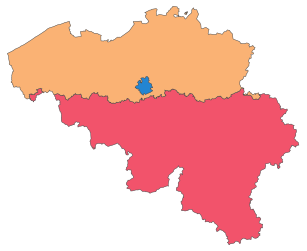
regional rules applying in Wallonia, Flanders and Brussels;
local signage decided by road authorities and municipalities.
For drivers, the practical consequence is simple: even with a clearer code, you will still need to check the local context before applying a rule automatically, especially for parking, urban road design and cycling infrastructure.
FAQ about the new Belgian highway code
When will the new Code de la voie publique take effect?
The official timetable now points to 1 June 2027. The postponement from 1 September 2026 was confirmed to give authorities and road users more time to prepare.
Will perpendicular parking be banned everywhere?
Not everywhere. The general rule on the carriageway becomes parallel parking, but a specific local layout can still organise a different setup. That means you will still need to read the signage and markings on site.
Will the green square exist at every intersection?
No. It is a device that requires a specific layout. Where it exists, it allows diagonal pedestrian crossing during a dedicated signal phase.
Will the rules be identical everywhere in Belgium?
The general framework is shared, but some regional rules and local implementation details will remain. In practice, you will still need to combine the Code, the signs on site and any regional specifics.
This article is intended as a practical overview. For exact legal application, always check the official text in force, the signage on site and any applicable regional rules.