Loading…
Intelligent speed cameras in Belgium: new fines, checks and risk zones in 2026
2026-05-09 · 8 min · Laura

TLDR
2026-05-09 · 8 min · Laura
Still thinking that a speed camera is just a visible box beside the motorway? That is no longer the Belgian reality. Belgium has moved towards far more automated road enforcement: number plates are read, average speeds are calculated, data is forwarded more quickly and fines can be processed more systematically.
For drivers, the change is practical: braking just before a fixed camera is no longer enough. On an average speed camera section, your average speed matters. With ANPR, your plate can be read without you noticing the check. With mobile cameras, the enforcement location can change from one day to the next.
Key point: in Belgium, the real novelty is not only the number of cameras. It is the coordination between detection, plate reading, automation and sanctions.

Speed remains one of the most common traffic offences in Belgium. The Justice FPS indicated that, in 2024, half of traffic offences were detected by average speed cameras and mobile cameras, while fixed cameras still represented a significant part of detections.
This explains why drivers feel they are receiving more fines even when they do not see more police officers on the road. Enforcement is becoming less visible, but more frequent and more automated.
Belgian authorities are pursuing several goals:
This is exactly the kind of question drivers search for when they see a speed control sign, enter an average speed camera section, cross a 30 km/h zone or receive a fine by post.
In Belgium, “intelligent speed camera” is not always one single legal category. It usually refers to several technologies that have one thing in common: they automate part of the enforcement process.
An average speed camera measures your average speed over a defined distance. The system reads your plate at the start of the section, reads it again at the end, calculates travel time and derives your average speed.
If that average speed exceeds the limit after technical correction, the offence can be forwarded to the competent services.
That is why average speed cameras are feared:
ANPR means Automatic Number Plate Recognition. These cameras read a vehicle’s plate and can feed enforcement systems or police platforms.
Depending on the legal framework and the device, they can be used for:
In Brussels, for example, cameras linked to low-emission zones and some average speed cameras are part of a more integrated network logic.
Mobile speed cameras are the most unpredictable for drivers. They can be moved according to risk zones, enforcement campaigns or local priorities.
Wallonia says it has around 280 fixed housings for enforcement radars and more than 125 mobile enforcement radars in unmarked police vehicles or mobile devices.
In practice, a mobile radar can be located:
The biggest change is not only “more cameras”. It is more systematic enforcement.
The Justice FPS has explained that tolerance margins on motorways were removed and that checks became stricter. But two ideas are often confused:
The technical margin remains unchanged:
| Speed limit | Technical margin applied | Practical example |
|---|---|---|
| Below 100 km/h | 6 km/h | A measured speed of 56 km/h can be corrected to 50 km/h. |
| Above 100 km/h | 6% | On a motorway limited to 120 km/h, a fine can be expected from around 129 km/h measured. |
In other words, the technical margin is not permission to drive faster. It is a measurement correction. In 2026, counting on “tolerance” is a poor strategy.
The immediate collection scale used by the Belgian authorities is easy to understand for small and medium speeding offences.
For the first 10 km/h above the limit, the base amount is €53.
Then a supplement is added per extra km/h:
| Type of zone | Supplement after the first 10 km/h |
|---|---|
| Built-up area | +€11/km/h |
| 30 km/h zone | +€11/km/h |
| Near schools | +€11/km/h |
| Residential or meeting zone | +€11/km/h |
| Other roads | +€6/km/h |
These amounts do not include possible administrative fees, including the administrative fee linked to processing the file.
| Situation | Indicative calculation | Indicative amount excluding fees |
|---|---|---|
| 57 km/h retained in a 50 zone | within the first 10 km/h | €53 |
| 45 km/h retained in a 30 zone | €53 + 5 × €11 | €108 |
| 132 km/h retained on a 120 motorway | €53 + 2 × €6 | €65 |
| 72 km/h retained in a 50 urban zone | €53 + 12 × €11 | €185 |
These examples explain the mechanism. The exact amount always depends on the retained speed, the location, the procedure and the fees stated on the notice.
Not every speeding offence ends up before a judge. But some thresholds clearly change the level of risk.
Referral to the public prosecutor becomes much more likely:
At that point, it is no longer just a small immediate collection. The driver may face:
The Justice FPS also reminds drivers that judicial fines are multiplied by additional surcharges. The current coefficient is 8, which can make the final amount much higher than the raw figure in the law.
Speed cameras are not installed randomly. Authorities generally justify their location with safety criteria: inappropriate speed, accidents, infrastructure, previous enforcement results or protection of vulnerable road users.
30 km/h zones are particularly sensitive because the scale rises faster after the first 10 km/h. The risk is high in:
The classic trap is driving “as before” in a street that has changed from 50 to 30 km/h.
Motorways and ring roads remain highly monitored, especially through average speed cameras and automated checks. Drivers should be particularly attentive on major corridors around:
This list should not be read as an exhaustive official map. The important point is that Belgium’s major roads combine dense traffic, high speeds and automated devices.
Roadworks zones are high-risk for three reasons:
On roadworks, the typical mistake is keeping motorway speed when the temporary limit has changed to 90, 70 or 50 km/h.
Regional roads are often affected by speeds that do not match the infrastructure: village crossings, dangerous junctions, school exits, bends, pedestrian crossings or repeated accident locations.
Wallonia states that radar placement takes objective criteria into account, including how speed fits the infrastructure and the location of accidents.
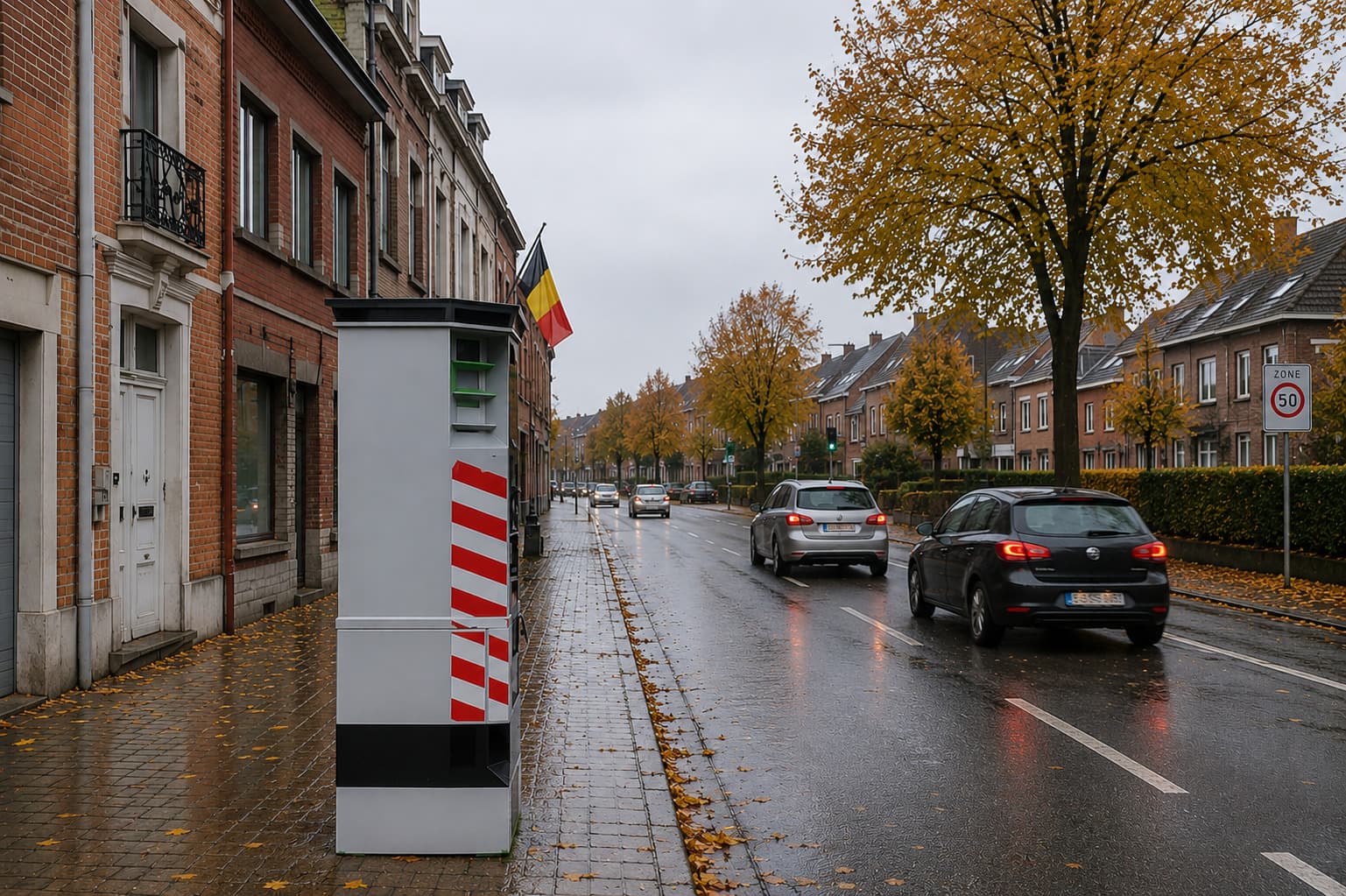
Belgium is a particular country for drivers because road enforcement combines federal, regional and local levels.
Flanders has invested heavily in average speed cameras and ANPR. This is also where the GAS 5 mechanism is especially important.
GAS 5 allows some local authorities to administratively sanction limited speeding offences, especially in 30 or 50 km/h zones, when the legal conditions are met. In practice, it strengthens local capacity to process small speeding offences without sending everything through the same criminal channel.
For drivers, the message is simple: a “small” local speeding offence can still be processed efficiently.
Brussels combines several issues:
It is a region where a speed-limit mistake can happen quickly, especially if you are not used to new urban limits.
Wallonia has many fixed housings and mobile enforcement radars. It also states that radars are installed according to criteria such as practised speed, enforcement results and accident locations.
Drivers should be especially careful on regional roads, village crossings, roadworks and roads where actual speed often exceeds safe speed.
Between 30, 50, 70, 90 and 120 km/h, roadworks and school zones, the risk of error increases. The issue is not always a desire to drive fast: sometimes the driver simply has not noticed the new limit.
With a classic fixed camera, some drivers braked before the box and accelerated again. With an average speed camera, that logic no longer works. The average is what matters.
An ANPR camera does not always look like a speed camera drivers immediately recognise. Many drivers do not realise they have been recorded.
The more automated processing becomes, the less the system depends on visible manual intervention. That increases the probability that a detected offence actually becomes a fine.
Police statistics show that most recorded speeding offences are small exceedances. This means the real risk for many drivers is not only a spectacular major offence, but the everyday habit of driving a few km/h too fast.
Belgium has digitised much of the traffic-fine process. The official Just-on-web portal can be used to consult, pay or contest certain fines, and to identify the responsible driver when required.
The practical rule is simple:
Be careful: an unfounded contestation can complicate the procedure. If the case is serious, if court risk exists or if your professional licence is at stake, seek specialist advice.
Yes. They measure a vehicle’s average speed between two points, often using ANPR cameras. If the retained speed exceeds the limit, the data can be forwarded according to the applicable procedure.
Yes. Wallonia mentions more than 125 mobile enforcement radars, and the Justice FPS says mobile cameras play an important role in recorded traffic offences.
The base amount is €53 for the first 10 km/h above the limit. Beyond that, the supplement depends on the road type: €11/km/h in urban and sensitive zones, or €6/km/h on other roads.
Yes. The supplement per km/h is higher in built-up areas, 30 km/h zones, near schools and in residential or meeting zones.
Yes, when the GAS 5 conditions are met. These are local administrative fines for some limited speeding offences, especially in 30 or 50 km/h zones.
No. It is a technical correction applied to the radar measurement, not permission to exceed the speed limit.
Yes. A significant share of detections is automated, including average speed cameras, fixed cameras, mobile cameras and ANPR systems.
Follow the procedure stated on the notice. The official Just-on-web portal can be used to consult, pay or contest certain fines, depending on the type of case.
Road enforcement in Belgium has become more digital, more automated and harder to anticipate visually. Drivers who still think only in terms of fixed cameras risk underestimating average speed cameras, ANPR cameras, mobile radars and automated processing.
The safest rule in 2026 is simple: drive at the actual posted limit, especially in towns, 30 km/h zones, near schools, on roadworks and through average speed camera sections.
The real trap is no longer just seeing the camera too late. It is not realising that the check has already started.